


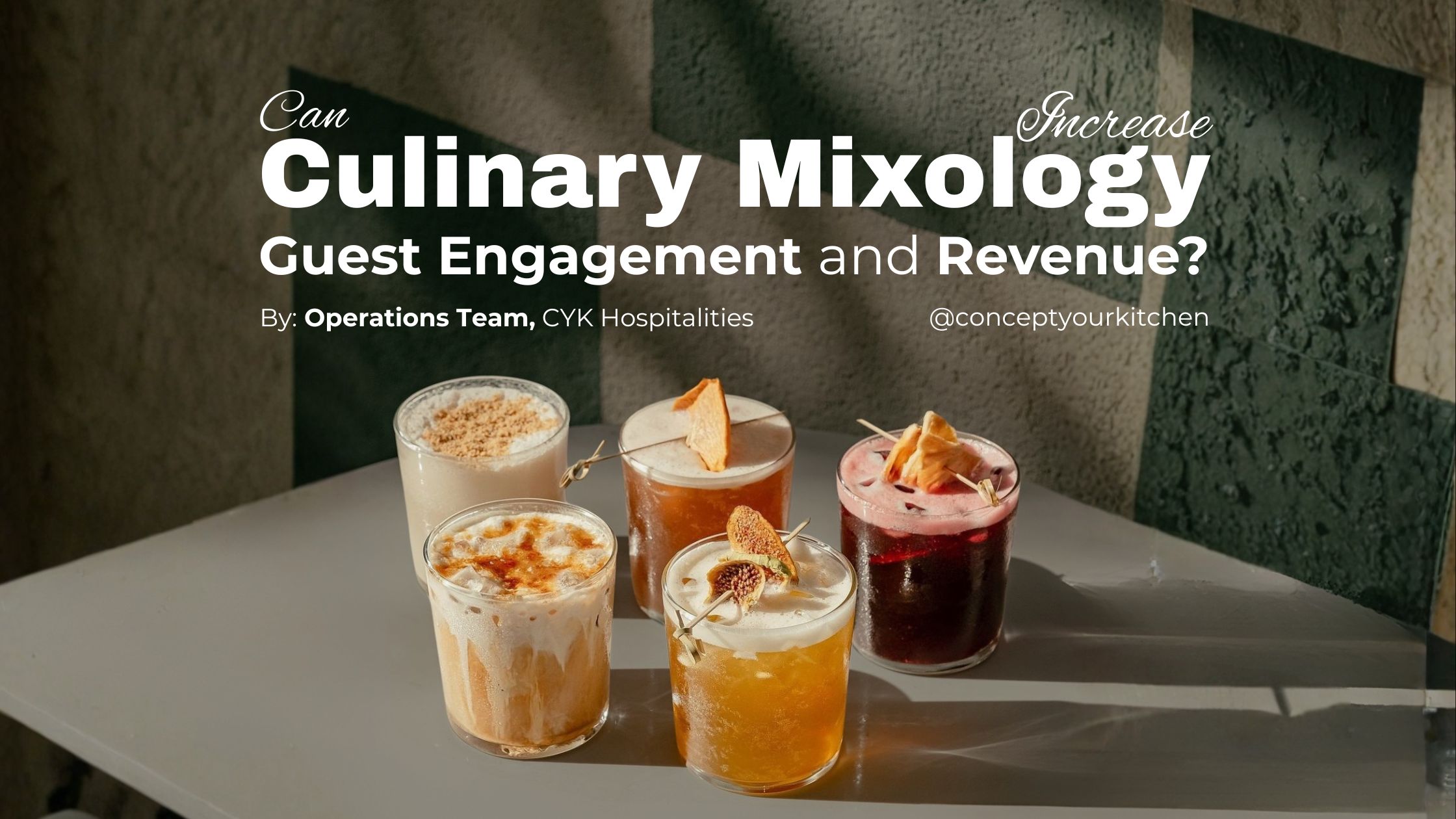
05 Jun Can Culinary Mixology Increase Guest Engagement and Revenue?
The contemporary bar is no longer confined to the boundaries of traditional mixology. In 2026, the evolution of beverage programs reflects a decisive shift toward culinary integration, where the bar operates as an extension of the kitchen rather than a standalone entity.
Culinary mixology has emerged as a discipline that merges gastronomic techniques with beverage craftsmanship, transforming drinks into multi-sensory experiences driven by texture, aroma, and narrative depth.
This progression signals a movement away from conventional cocktail frameworks toward a flavour-first philosophy, where ingredients are treated with the same respect and precision as in fine dining kitchens.
The global beverage landscape indicates a strong upward trend in experimental and technique-driven drinking, with consumers increasingly gravitating toward ingredient transparency, functional value, and immersive storytelling.
Processes such as fermentation, fat-washing, clarification, distillation, and infusion are no longer niche practices but foundational tools in progressive bar programs.
A recent industry analysis highlights that establishments incorporating culinary techniques into their beverage offerings report higher guest engagement and increased average spend per cover, driven by perceived value and uniqueness.
Case studies from leading hospitality markets demonstrate that bars adopting kitchen-led R&D models consistently outperform traditional formats in both brand recall and experiential differentiation.
At its core, culinary mixology redefines the role of the bartender from a drink maker to a flavour architect. The integration of kitchen infrastructure within bar operations enables cross-utilization of ingredients, reduction of waste, and development of hyper-seasonal menus. Elements such as house-made ferments, botanical extracts, and savoury components introduce complexity that extends beyond sweetness and acidity. This convergence also aligns with the growing demand for low-ABV and no-ABV beverages, where culinary techniques provide depth and structure in the absence of alcohol.
However, the transition is not without its challenges. The adoption of culinary mixology requires operational discipline, technical training, and cost management, as the complexity of preparation increases significantly. Industry reports suggest that without structured systems, bars risk inefficiencies similar to those observed in early-stage fine dining kitchens, highlighting the need for process-driven execution alongside creative innovation.
CYK’s Perspective
Culinary mixology represents a fundamental shift in how beverages are conceptualized, produced, and consumed. It is not merely a trend but a reflection of a more informed and experience-driven consumer mindset.
In the future of hospitality, the distinction between kitchen and bar will continue to dissolve, giving rise to unified spaces where flavour, technique, and storytelling coexist seamlessly.
We assert that while traditional mixology laid the foundation, culinary mixology defines the next era, where every drink is not just served, but crafted with intent, precision, and narrative value
Sorry, the comment form is closed at this time.